It’s Scorpio season, a time of descending darkness as we cling to the light, our shadow selves coming out to play. Lore tells us the veil between the living and the dead, the other spiritual realms, is thinnest at this time, thus our celebrations of Halloween, Samhain, Dia de Muertos and many other customs, such as our gratitude to the autumn harvest before the cold of winter in the Western Hemisphere. This is soup season. Squash season. Curl up in a blanket with a warm beverage season.
Our travels the last few weeks have taken us from Virginia, where I turned 39 and we said goodbye to our sweet Chanchito, to Philadelphia to visit friends we haven’t seen in person since before the pandemic! It was a beautiful gift to spend time with them and their little one and be a part of their lives for a brief time.
We also got to explore different parts of Philadelphia, including historical sites and many beautiful green spaces full of autumnal beauty. We had the opportunity to go to the Harvest Festival at the Awbury Arboretum where we drank fresh milled cider, connected with local artists and vendors, and got to explore the food forest and the Weaver Way Farms that is part of a co-op where we had previously shopped. I also got to explore the Little Free Library on the property, some zine activities they offered, which I appreciated since we missed the Philly Zine Festival by one day, though I did get a free community arts zine by sticking my hand in this repurposed newspaper stand!


I also really loved that the Arboretum had a wind phone, which I am only just now learning more about and want to explore further as a way that people navigate their grief and connections to loved ones who have passed on. As I return to working on my paranormal historical novel about Spiritualism in my hometown of Austin, grief and death rituals are close on my mind, and I loved to see this particular offering to the local community made here.

Seeing the ofrendas in the markets we visited in Philly also motivated me to finally make our own memorial for our beloved dogs, Petey and Chancho, who have both passed on, using their footprints.

While in this historic city, especially around Halloween and Dia de Muertos, I got to thinking a lot about life and death (don’t I always?) and who or what we remember or memorialize in our collective histories. This city is the former capitol of the early United States post-Revolutionary War and is one of the oldest cities in the country. Benjamin Franklin’s monuments, statues and name are everywhere. There is Independence Hall and countless monuments to the “Founding Father’s of this nation state who undeniably shaped the foundation of the country we live in today. Of course we visited some of these iconic sites, as tourists are want to do, but I have always made it a point when traveling to critically examine where I visit and why, looking for opportunities to engage in a city’s culture beyond their most famous sites of interest. There is often so little time to experience everything we want to in any particular city, so I want those places we visit to be both interesting and meaningful.
Looking at these countless monuments to men like George Washington, Thomas Jefferson and Benjamin Franklin, whose legacies are well protected in the United States despite the fact that all of them, and many other statesmen we learn about in American history, were actively engaged in the brutality of slavery and creating a nation predicated on the inequality and subjugation of BIPOC peoples. This is not a new conversation, and Howard Zinn’s work, as well as other authors who have discussed US history through Black, Latinx and Indigenous lenses, can discuss these topics far better than I can. What I am reflecting on in our travels is who our US culture memorializes, remembers, and offers up as seemingly uncomplicated examples of American ideals, especially freedom.
As a teen growing up post-911, the ways that US patriotism was utilized by the Bush administration and so many other politicians, pundits and artists to manufacture consent for the invasion and war on Afghanistan and Iraq always felt wrong to me. It made me uncomfortable that I was expected to pledge allegiance to an imperialist country doing untold harm to other countries in the name of protecting American freedom, aka American capitalist and imperialist interests, while the wealth gap in the US continued to widen and the future that many of us imagined seemed to shrink.
In our travels, I have seen told numbers of US flags, variations on those flags, confederate flags, and other symbols that immediately fill me with trepidation and anger. Flags themselves are not necessarily inherently violent, but in the context of US imperialism and our descent further into fascism, pledging allegiance to these symbols that have never meant freedom to me nor to many others seems a bizarre, uncritical ritual I don’t feel inclined to participate in. I am reminded of Sudanese-American poet Safia Elhillo’s poem, “Self-Portrait with No Flag,” especially the line, “i choose the world we make with our living refusing to be unmade by what surrounds us.” On the eve of another Election Day when both federal, state and local governments are often not just not representing the people they are supposed to serve, but actively stripping away our human rights, I am reminded of where my allegiance lies; with community, with real people doing the small but important acts of good that sustain and help people thrive.
Much of a nation is built on its own storytelling, its own myth making. As a storyteller, I often ask myself what stories feel most important for me to tell. But I am also interested, especially as I travel, in the folklore and historical stories of a place that contributes to how a particular community or place thinks of themselves. Sometimes these are in ghost stories, urban legends, historical archives and more.
Yesterday we visited Sleepy Hollow, NY, which has been on my travel wish list for some time. We toured the historic Sleepy Hollow Cemetery, a boon for my macabre little heart, and got to visits some local shops, including Cozy Coven and Sleepy Hollow Bookshop. During our time there, I was reminded again of who historically is honored and memorialized, especially in death as much as in life. There were many gravestones in the cemetery so monumental and large they took up the entirety of the plot, often the patriarchs of a particular local family of renown whose monuments towered above his wife and children. Many were so weathered that their names had disappeared altogether, known now only to those historians and archivists who keep this knowledge. As we walked in this undeniably tranquil cemetery, contemplating all the people buried there, including Washington Irving, I thought of all the people who might not have burial sites this grand, or markers to their names at all. In one of my previous newsletter posts, “Living Histories,” I discussed visited Evergreen Cemetery in Charleston, SC and reading Over My Dead Body: Unearthing the Hidden History of America’s Cemeteries by Greg Melville. I couldn’t help but think again about the chapter in Melville’s book telling the segregationist histories of early American cemeteries and how Sally Hemming’s family was barred from being buried in Thomas Jefferson’s family plot at Monticello despite their direction relationship to the family. Again and again, this country reminds us whose stories, whose lives are deemed worth remembering and honoring over others. This is why I started adding books to my reading list that are set in or written by authors from each region we visit, including My Monticello by Jocelyn Nicole Johnson. I’ll include a full list in my last newsletter of 2025 in December.
As we explored Sleepy Hollow, I was heartened to see the mix of cultures present in this historical town. Most of the signs were in English and Spanish, some in multiple languages, and there was clearly a large Latinx community present there. As we walked along the trail by the Hudson River, we saw some awesome artwork by local students, including this one as an homage to the Legend of Sleepy Hollow while also representing the variety of cultures and nationalities that now make up this town. It’s good to know that younger generations, who may or may not feel connected to the legends and stories of their town, are making them their own.

So here’s a little journal prompt for you, whoever is reading:
What or who is worth creating a monument or memorial to in your life? How would you honor them?
Let me know if you wrote something in the comments!
To find more photos and videos of our travels, follow me on Instagram or Tiktok!

If you’re interested in becoming a paid subscriber to support the newsletter and my work, I’d love to have you! Just $5 a month will help me continue to offer curated book recommendations, writing prompts, author spotlights, resources and more! You will also receive discounts on future workshops and editing services. It’s hard to be an independent artist, and your monthly support helps make my work more sustainable.
What’s Happening with Leticia?
As I work on several projects in progress, I am also revising my poetry chapbook that will be out in the coming month (details TBA) and my next book horror collection, The Remedy is the Disease, out next May from Undertaker Books. As I plan for the release of my next two books, I am also visiting bookstores in the areas where we are traveling to plan book release events, workshops and more.
Do you have any bookshops I should visit or reach out to in the north east (besides in New York City)? Comment and let me know!
I am also getting back into freelancing again, so if you have a publication or blog you are seeking writers for, I would love to work with you! Here are two pieces I wrote recently:
- “10 Books About the Diversity of Disabled Experiences“ with Electric Lit.
- “Creeping Fungus: works of Sporror” with Reactor Magazine.
Creature Feature Recap!

Didn’t get to attend the workshop? You can purchase the workshop slides with links to readings and materials to write your own creepy story at home at your own pace. Purchase materials here!
Other Services I Offer
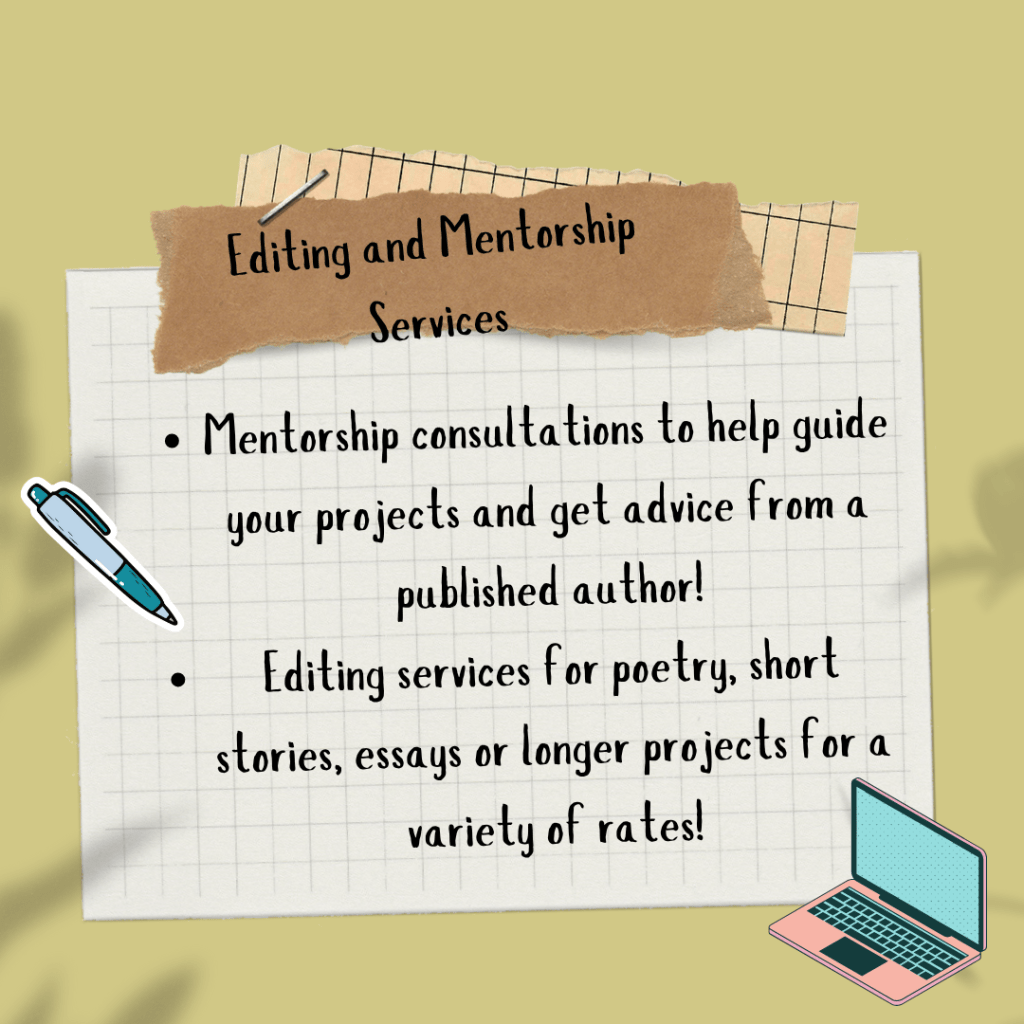
I also offer editing and consulting services to help you with your own creative projects! I have over a decade of experience helping writers of all ages develop their creative voices and their work with a caring and supportive approach. I love helping people learn more about their creative processes to best tell their stories.
I am currently taking on clients ages 16 and up for my services, although if your child would like support honing and publishing their work, I am happy to work with younger clients upon request. Since I write across a variety of genres, I am able to work with folks who are writing poetry, creative nonfiction, short stories, novels and more, with a special place in my heart for horror, speculative fiction and fantasy. If you are working on a comic, that is fantastic. I would love to work with you! Or, please share with other writers you know who might be interested!
Giveaway!
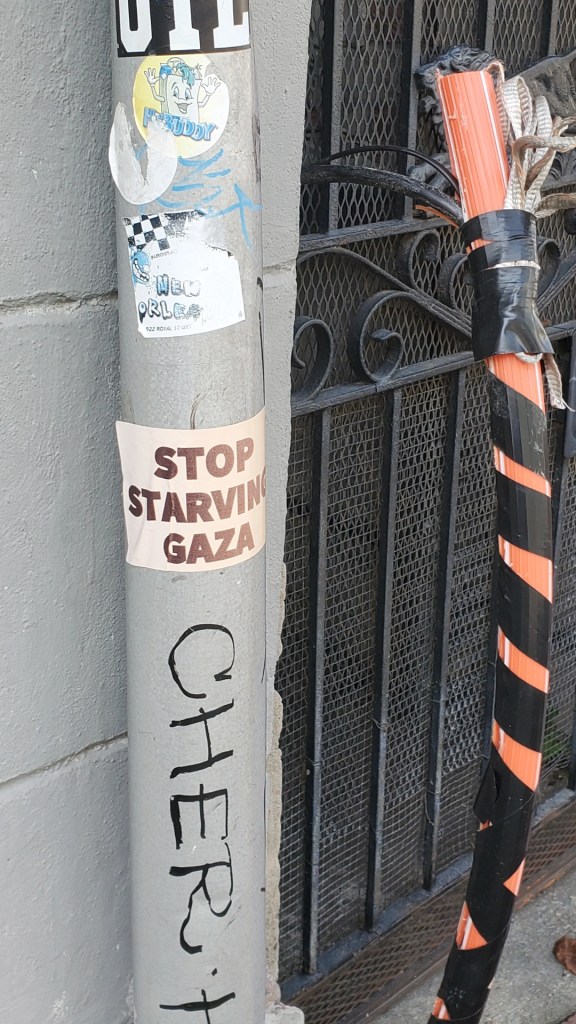
I am offering free one-hour editing/writing mentorship consultations for the first few folks who donate $20 or more to The Sameer Project, a grassroots organization of Palestinian volunteers who are working tirelessly to provide meals, baby formula, water and medical supplies to families in Gaza despite the increased Israeli bombardment despite the “ceasefire” and blockade of aid which is supposed to be delivered. Comment or email me to let me know once you’ve donated and we can schedule a time to chat!
What I’m Reading and Watching: Vampires, Werewolves and Creatures, Oh My!
Thinking a lot about the intersections of life and death and preparing for my Creature Feature workshop, I naturally want to talk about vampires, werewolves and more! Let me explain.
Last year I re-read one of my favorite novels of all time, Frankenstein by Mary Shelley. I also read other novels and works inspired by Frankenstein. This year, it seemed fitting to re-read another gothic novel, and because vampires seemed very much a part of the cultural conversation again, I chose to re-read Dracula and make this, 2025, the year of the vampire.
I was in college when the Twilight books came out, and as a fan of Interview with a Vampire and the gothic origins of Dracula, I remember even then laughing at the sparkly Cullens and the strange debates about being Team Edward vs Team Jacob.
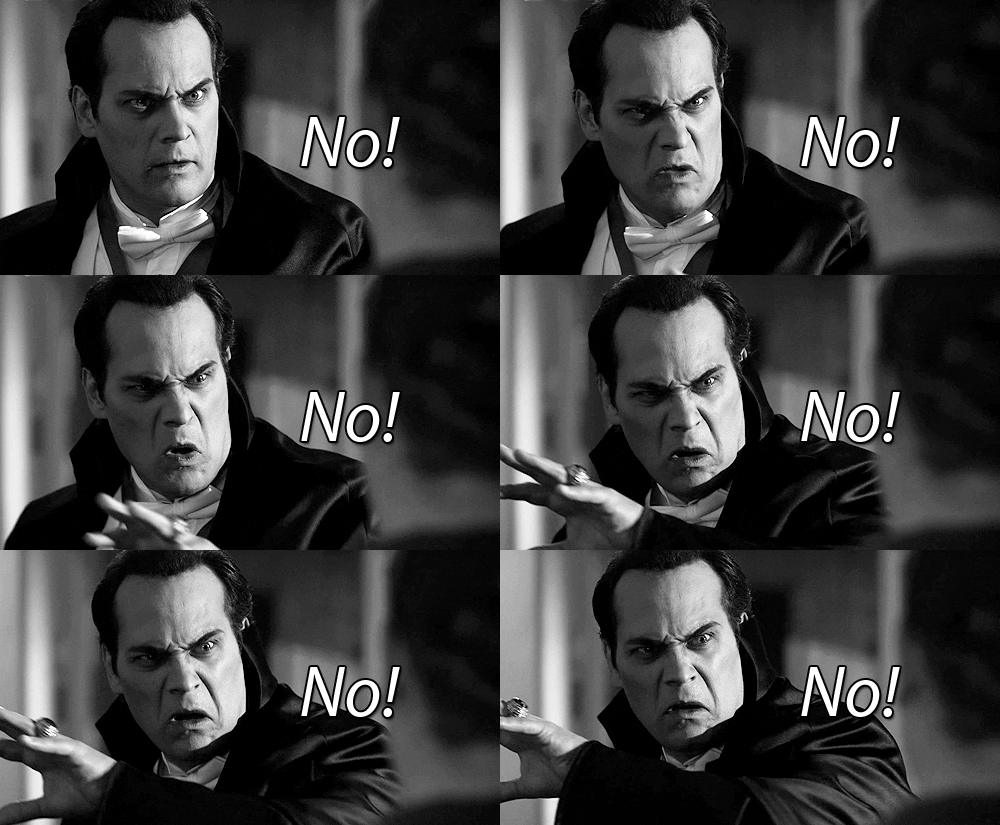
When I was younger, I was a fan of Nosferatu and his appearance in the episode of Are You Afraid of the Dark: The Tale of the Midnight Madness in which the eponimous vampire is released from the silver screen to attack unsuspecting teen theater employees Pete and Katie, who are just trying to save their dying historical theater.
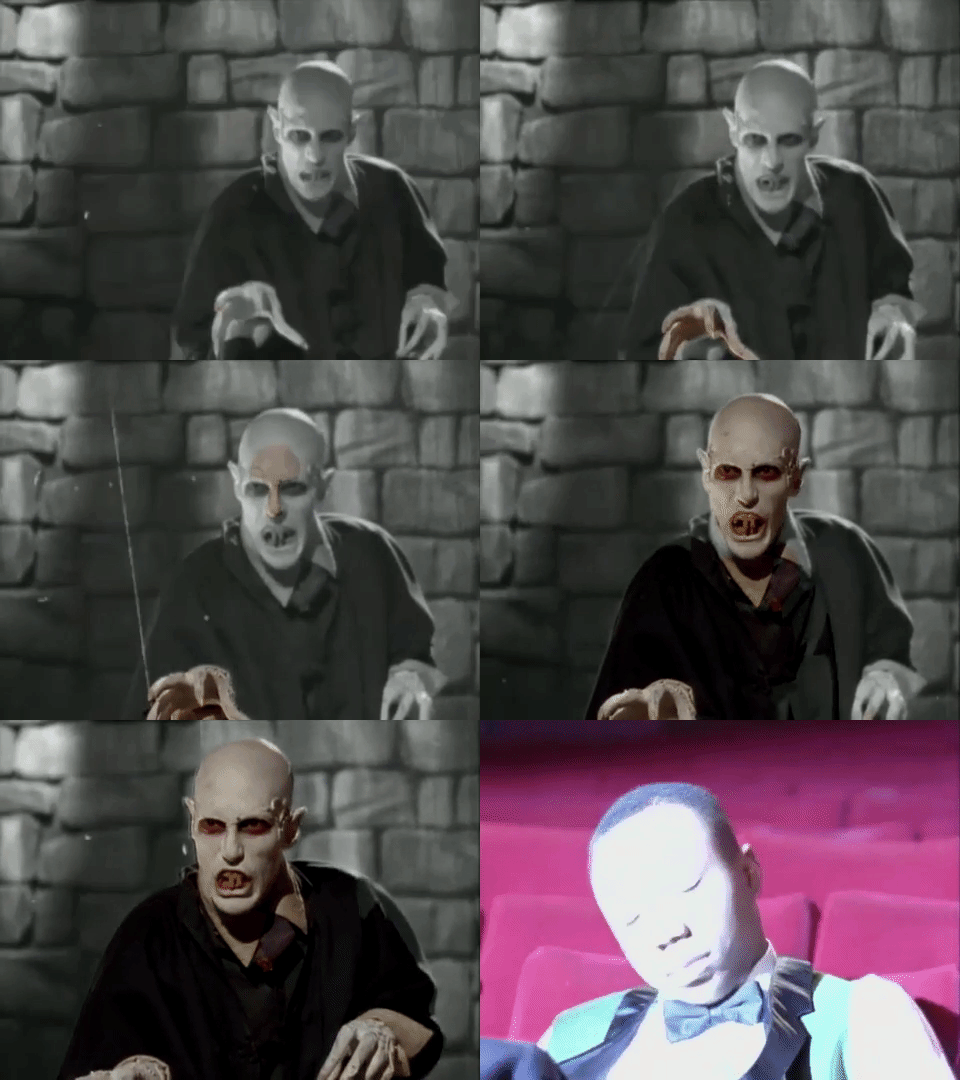
Vampires to me then needed to be grotesque, and above all, frightening! It’s another reason I love the frightening, ancient vampires of 30 Days of Night (both the film and comics). Then, I read and studied Bram Stoker’s Dracula as a scholar in a gothic literature class at Agnes Scott College. Many literary historians discussed how folkloric vampire stories that inspired Dracula dealt with common fears of the undead or uncanny, of vampirism as contagion or disease. In Dracula, Stoker also uses the fears of the foreigner or immigrant in Dracula’s character, as well as the cultural fears of women’s sexual desires and empowerment as seen in Lucy and Mina’s characters. There is also much scholarship that suggests Stoker alluded to vampirism as sexual deviation or queerness in the sharing of fluids and blood, possibly influenced by the criminal trails his friend Oscar Wilde, was then undergoing for being an openly gay man, and Stoker’s own struggles with his sexuality. Sasha Coward discusses the queer storytelling inherent in vampire tales in his book, Queer as Folklore, which I highly recommend, especially the chapter, “Children of the Night.”
I remembered as a teen why I was drawn to the darkly atmospheric Underworld films and Blade, or even Buff the Vampire Slayer, where vampirism also represented ancient blood feuds, inequality among the creatures of the night and being at odds with human society, or operating behind the curtains in secret while warriors took them down.
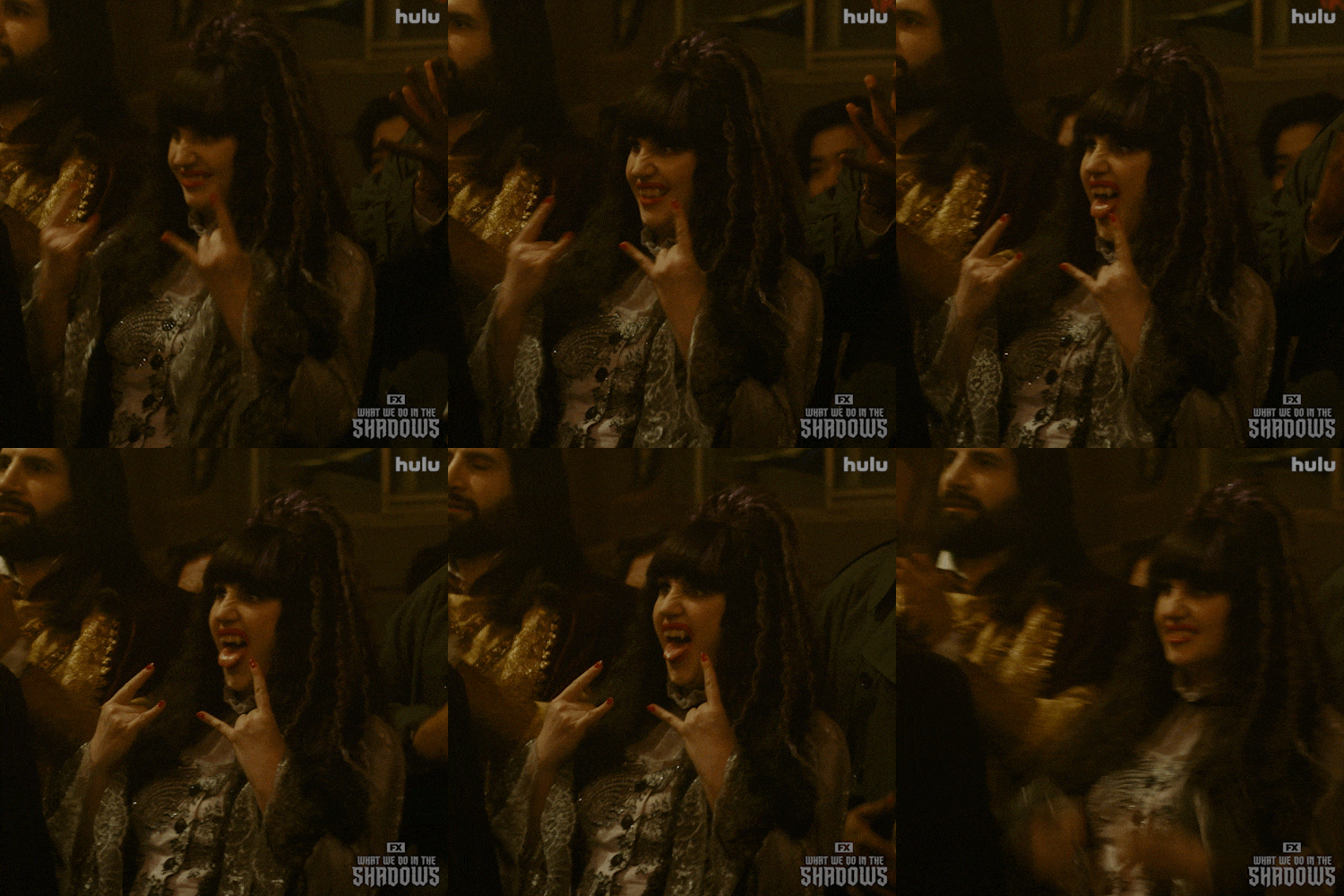
As an adult, I fell in love with the film and tv series, What We Do in the Shadows, a rich horror comedy about a found family of vampires trying to live their undead lives in Staten Island, NY. Also an incredibly queer show and one that made my heart happy always.
I also love the interpretations of other stories to create creatures that are vampire-adjacent, like the True Knot in Stephen King’s Doctor Sleep, which Mike Flanagan’s film adaptation, possibly the best King film adaptation in my opinion, depicts incredibly with Rebecca Ferguson as Rose the Hat, a character both terrifying and alluring in equal measure.
I have watched Doctor Sleep a million times and can never get enough because it is both an incredible interpretation and sequel to The Shining (film and novel), as well as story about the True Knot, a loving, close knit family of quasi-immortal humanoid creatures, much like vampires, except they murder and feed off of the psychic energy of anyone that shines. I must confess, when I re-watched this film last week, I was also admiring their tastefully decorated RV’s.
Last year, AMC created an Interview with a Vampire which I am loving as a reinterpretation of Anne Rice’s iconic series, with incredible acting by Jacob Anderson of Game of Thrones fame. This series is an incredible interpretation of the novel while including more interesting critiques of the racist systems Louis is born into and much more overtly queer as his relationships with Lestat and Armand develop. I highly recommend it!
In December of 2024, Nosferatu arrived on the scene with incredible performances by Bill Skarsgard and Lily Depp. I loved this interpretation of both the original silent Nosferatu film and Dracula, making Count Orlak frightening, grotesque and sexually alluring in equal measure, and the historical attention to detail that Robert Eggers included was excellent. That is exactly what tension that vampire lore around the world plays with.
There was also the most recent The Last Voyage of the Demeter, which imagined what happened on to the crew of the Demeter, the ship that Count Dracula uses to travel to London. A gruesome and very horror forward film! Also, Abigail was a great twist on the vampire film mixed with a heist film that was gory good fun.
Then, of course, Ryan Coogler’s Sinners released this year, and this film completely re-imagined the role of vampires in folklore again! Besides the fact that it is an incredible film about the power of music as cultural memory (if you haven’t seen it yet, stop reading here and go watch it!), what it means to be a sinner in both religious and moral senses, the horrors of racism in the Jim Crow south and how Black folks and other people of color historically found ways to create free lives with those they love after the trauma of war and grief at losing loved ones. The historical attention to detail, the incredible cinematography and acting by the entire cast made this a film that could have existed all on its own as a drama without the vampires. But then there are vampires!
Remmick as an ancient Irish vampire of folklore who wishes to create his own vampire found family is both an offering and a threat. He wants to use Sammy, arguably the protagonist of the film, whose blues music is so beautifully powerful that it can pierce the veil, allowing Remmick the chance to reconnect with who he was in the past, and those he has lost. For one of many great breakdowns I read about the many layered meanings in the film, read this review from Screen Rant (but watch the film first, this contains spoilers!), or listen to this excellent episode of one of my favorite politics and culture podcast, Bad Faith, for their breakdown.
Vampires are the unnatural historical memories. They represent so much across folklore and cultures, both as threats of death and violence, of the consumption of people’s life force, even their souls, but also our struggles with sexuality and desire, our relationships to life and death, and finding found family, even community, among those outcasts who live in the margins. They are often opportunities to reflect on our shadow selves, and what makes us human. Here are some books I am reading or will be reading related to Dracula and other vampire stories:
- Carmilla by Joseph Sheridan Le Fanu
- A must read that came before Dracula was written and is considered the progenitor of sapphic vampire stories!
- Hungerstone by Kat Dunn
- A re-imagining of Carmilla also on my list. Very excited about this one!
- Lucy Undying by Kiersten White
- Lucy is by far one of the more interesting characters in Dracula, and this novel imagines Lucy trying to take control of her own undead life after being turned by Dracula in the original novel.
- Buffalo Buffalo Hunter by Stephen Graham Jones
- Can’t recommend this one enough, especially the audiobook, which has incredible voice actors! In this novel, a Lutheran minister in 1912 Montana encounters a mysterious Blackfeet warrior with tales of the US army’s massacre of his people and his own undead transformation. The more each of them reveals their stories, the more entwined their stories become. The link above, written by a horror author I admire, Gabino Iglesias, is worth reading to get a sense of this historical horror novel and it’s importance.
- Of Monsters and Mainframes by Barbara Truelove
- An interesting sci-fi imagining of the Demeter, the ship from Dracula, who is re-imagined in this book as an AI spaceship transporting passengers from Earth to Alpha Centauri. But when famous monsters from your favorite gothic stories begin using the Demeter as a transport and place to feed, this operating system must use the other robots and some humans on board to defeat the monsters and maintain control of the ship. It’s an interesting ride so far!
- Night Owls by A.R. Vishny
- This novel follows two vampiric sisters, Molly and Clara, who run a Yiddish theater in Manhattan and are Estries, undead women from Ashkenazi lore who turn into blood-drinking monsters and can fly around on owls’ wings. Though they have kept their identities a secret for many years, new love interests and supernatural happenings threaten to reveal their secrets. I love that this explores vampiric Jewish folklore!
- Immortal Dark by Tigest Girma
- This debut novel is dark academia and vampire lore rolled into one. In it, orphaned heiress Kidan Adane grew up far from the arcane society she was born into, where human bloodlines gain power through vampire companionship. When her sister, June, disappears, Kidan is convinced a vampire stole her—the very vampire bound to their family, the cruel yet captivating Susenyos Sagad. Kidan decides to search for her sister at the elite Uxlay University—where students study to ensure peaceful coexistence between humans and vampires and inherit their family legacies. But the further she goes into this underworld, the more she risks giving into this bloody legacy. This one has been on high on my TBR and I am committed to reading it before the year ends!
- So Thirsty by Rachel Harrison
- Rachel Harrison is an auto-read author for me. I have read two of her novels now and have many more on my list. Her vampire novel about two friends who unwittingly cross paths with vampires on a friend vacation and are turned, having to navigate their now undead life was a gruesome, gory, and ultimately loving good time.
I have many more on my TBR, including Immortal Pleasures by V Castro, Vampires of El Norte by Isabel Canas, Reluctant Immortals by Gwendolyn Kiste, The Madness by Dawn Kurtagich, and Thirst by Marina Yuszczuk to name a few! What else should be on my list? Comment below!
This wouldn’t be a discussion about creatures without talking about werewolves. Werewolves are often pitted against vampires in popular media, but why? When asked which monster I preferred, I would often say werewolves. They always seemed more interesting to me, and are great representations of how many folks with chronic illness or mental health struggles feel out of control in our bodies. I included a werewolf story in my next story collection, The Remedy is the Disease.
In Underworld, vampires are at war with the Lycans, werewolves who were once enslaved to them and have since rebelled.
In the infinitely campy Van Helsing (still one of my favorites), Dracula uses werewolves to spawn his own vampiric offspring.
In contrast to vampires, who are often depicted in popular media as attractive, alluring, aristocratic, in control (until they feed), whereas werewolves are often representations of the uncontrollable, animal side of ourselves. Here are some of my favorite werewolf books I’ve read or have on my TBR:
- Howl: An Indigenous Anthology of Wolves, Werewolves, and Rougarou
- This is an incredible comics anthology by Indigenous creators, mostly in North America.
- Squad by Maggie Tokuda-Hall
- The Craft or Meangirls meets werewolves in this sapphic graphic novel about Becca, who moves to a suburb in San Francisco and is invited to join an exclusive clique in her school. Turns out, they were be more dangerous than they seem!
- Such Sharp Teeth by Rachel Harrison
- Another favorite by Rachel Harrison. Use the link above for a full summary and my review.
- Wherewolf by Rob Saucedo
- A werewolf graphic novel that takes place in Texas? Sign me up! I bought this from Rob at the Ghoulish Book Festival in 2023 and have enjoyed it so far!
- Bored Gay Werewolf by Tony Santorella
- Werewolves have a long history of queer connotations in folklore, so I love that Santorella is writing a gay protagonist in this book. Brian, a college dropout with a dead-end job, a messy apartment, and a werewolf problem, is just trying to get through life one full moon at a time. Then he meets Tyler, an “alpha” and is taken under his wing, given space in a pack that is both welcoming and toxic. I love this book seems to play with how this is like queer spaces, especially toxic masculine spaces that make it challenging for vulnerable men to connect with others.
- Good Dogs by Brian Asman
- In this novel, Delia is trying to navigate being a werewolf and find her place in the world while she deals with childhood trauma and feeling out of control of her own life, like so many other werewolves like her. Delia forms a pack, becoming the unlikely den mother to a bunch of other werewolves in need in Southern California, trying to help them control the change and their identities together. But when someone is killed nearby, they must decide whether to cut and run or stay, and face the consequences. I’m excited to read this one!
- When the Wolf Comes Home by Nat Cassidy
- I like Nat Cassidy’s work, and have a hold on this audiobook through Libby coming up soon. In it, Jess, a struggling actress, finds a five-year-old runaway hiding in the bushes outside her apartment. After a violent encounter with the boy’s father, she and the boy find themselves running for their lives. But Jess doesn’t understand what she’s up against, or what is after them.
Werewolf media I enjoy: The Beast Within, The Wolfman (2010)-I am also looking forward to the new one!, An American Werewolf in London, Werewolves Within to name a few. What else should be on my list?
Bonus Creature Feature Reading Recommendations: Salt Bones by Jennifer Givan, These Vengeful Wishes by Vanessa Montalban and Never Whistle at Night: An Indigenous Dark Fiction Anthology (will discuss more in my next newsletter!).
Writing Prompts
What folklore creatures are you most familiar with in the lore of your childhood, region, culture, family, etc? What cautionary tales, familial tales, urban legends or folktales did you grow up hearing that reminded you to come home before dark? How do you feel about them now?
Want the complete Creature Feature workshop slides and activities? You can purchase them here!
Call to Action: Opportunities for Solidarity and Care
Sometimes it feels like there are too many crises to count, but each of us can do our part to show care in ways big and small, via education, aid, and direct action every day. I continue to share the work of the Sameer Project because they are a grassroots group of Palestinians doing everything they can to help their fellow Palestinians in need under the worst possible circumstances.
Millions of people in the US are about to lose access to their SNAP benefits at a time in which many folks are already struggling with inflation and food insecurity. Looking up your local food banks, free fridges and mutual aid initiatives can be helpful to see what they need and how they are supporting your communities.
Part of finding peace and connection within ourselves is also working a little each day to ensure that others are afforded the same opportunities and access to have comfort and peace in their lives too.
Take care, each and every day ❤️
Leticia
Discover more from Leticia Urieta
Subscribe to get the latest posts sent to your email.
