
There is a story I’ve told about my body, and then there is the story my body demands to be told. This has changed many times over the course of my 39 years of life, and I’m sure it will change many more times for the rest of my remaining years. There was a time I didn’t believe I was ill enough to call myself “disabled,” because I could still appear “abled” to the outside world. I was afraid of ableism, including my internalized ableism, and being treated as a burden by our deeply ableist capitalist society. But as I have navigated more diagnoses and needed more, different types of care, it has become apparent that these chronic invisible illnesses impact my daily life.
I was journaling recently about health issues I had when I was younger, warning signs of things to come: chronic headaches in first grade during a time of great stress that would have me lying down in the nurse’s office almost every afternoon with a cold washrag over my eyes. Restless legs, shin splints when I ran track and excruciating “growing pains” that may have been a precursor for my fibromyalgia diagnosis. Understanding how my younger self and my current self are connected by these ailments doesn’t necessarily help me to navigate being chronically ill, but they do help me to extend myself more tenderness, as I wish I could do to my younger self who didn’t understand why she caught every virus her friends and family had but suffered worse outcomes, and or how her energy outpaced her ability to run long distances without getting winded because of early asthma. If I had learned to accept my disabled-self sooner, I might have also mitigated the ways I have, knowingly or not, perpetuated ableism.
But why am I writing about this in a blog that is supposed to be focused on writing and creativity? Because being disabled, naming that as a part of my life experience, is inextricable from my creative life. My chronic fatigue and pain may mean that there will be days I only have energy for so many tasks in a day, and being creative isn’t one of them. Migraine days are bed days, where I allow myself to withdraw, although migraine dreams sometimes inspire my creepiest, most surreal work. Much of my next book, The Remedy is the Disease, out next May from Undertaker Books, was informed and inspired by my experiences with chronic illness and pain, loss and medical trauma.
July is Disability Pride Month in celebration of disabled people’s experiences and commemorating the signing of the Americans with Disabilities Act or ADA. And yet ableism touches almost every aspect of our society. HHS under RFK Jr. is actively spouting eugenicist propaganda that is incredibly dangerous for disabled people. The “Big Beautiful Bill” that was just signed into law by Trump will cut billions from Medicaid, Medicare and funding for SNAP and rural hospitals, meaning that an already broken healthcare system will crumble and people will lose benefits they need to live.
When I plan a workshop or event, thinking about making the space as accessible as possible in a variety of ways is often top of mind. But in our ableist society, this is often easier said than done, and I, like many others, am still learning that accessibility is a different need for everyone, and that sometimes access needs conflict and the resources might be challenging to provide. This is why other disabled kin in my life have been instrumental in learning more about disability justice and how it is imperative to learn about and embrace for a more accessible and liberated world for all.
If you are unfamiliar, a good place to begin understanding Disability Justice is to become familiar with Sins Invalid, which is a “disability justice-based movement building and performance project that celebrates disabled people, centering and led by disabled Black, Indigenous, and people of the global majority, and queer, trans, and nonbinary disabled people.” Their “10 Principles of Disability Justice” resource is a great place to begin understanding Disability Justice and how it is imperative to building sustainable movements and futures. If you are a creator, organizer, teacher and/or community member, these are principles that can pertain to all spaces, whether it is a writers conference, workshop, reading event/open mic, online community space, potluck and more!
What’s Happening with Leticia?
As I prepare to leave Texas at the end of this month and begin our cross-country travels, I am working on finding the rhythm of what my days and creative time will look like. We are living through pretty messed up times that make me feel dysregulated on a daily basis, so spending at least two hours in the morning stretching, drinking my morning coffee or tea and reading has been really helpful to help my mind focus on what I want to work on that day.
When I first left fulltime work, I told myself that I was going to give myself a week to rest, then dive right back into my creative projects. After having tea with a friend recently, she reminded me that considering how long I was at my last job and how hard the world around us is, that is probably not enough time. So instead, I am orienting myself towards more open creative time that don’t necessarily fit into a capitalist mentality of productivity, I can feel out where my creative energy is on any given day. Yes, I have several projects I’d like to finish this year (novel, graphic novel, book edits), but I also want to feel good about my work, rather than meeting a forced metric that doesn’t align with my energy. That’s just me, being a mood writer!
Here are some of the things I am working on outside of my creative projects that I can offer to you!
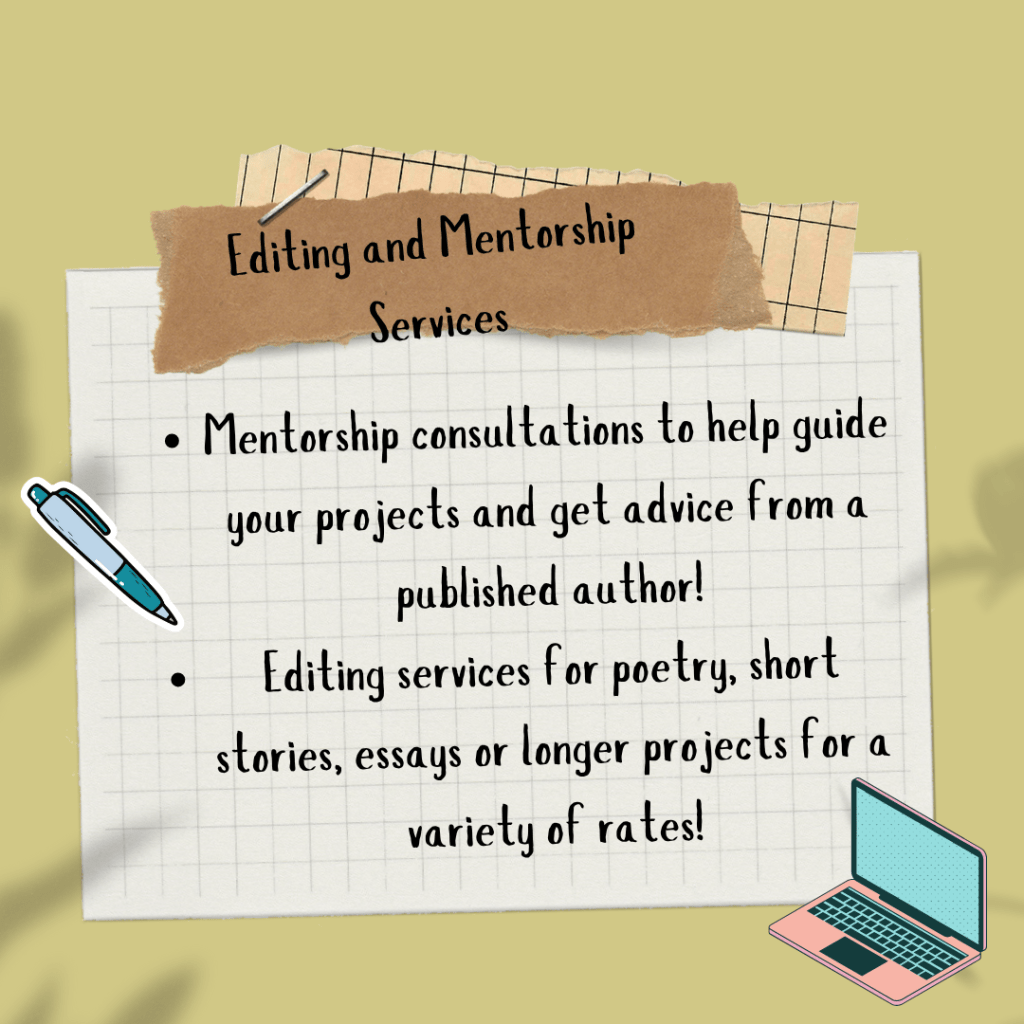
I offer editing and consulting services to help you with your own creative projects! I have over a decade of experience helping writers of all ages develop their creative voices and their work with a caring and supportive approach. I love helping people learn more about their creative processes to best tell their stories.
I am currently taking on clients ages 16 and up for my services, although if your child would like support honing and publishing their work, I am happy to work with younger clients upon request. Since I write across a variety of genres, I am able to work with folks who are writing poetry, creative nonfiction, short stories, novels and more, with a special place in my heart for horror, speculative fiction and fantasy. If you are working on a comic, that is fantastic. I would love to work with you! Or, please share with other writers you know who might be interested!
In an effort to make my work with Leticia’s Creative Obsessions more sustainable, I am asking that my subscribers sign up for a monthly fee of $5 in order to access the book recommendations, writing prompts and other new content! What else will you get access to as a paid subscriber?
A 20% discount on my editorial services! Exclusive access to my upcoming workshops! Additional posts throughout the month! And more coming!
Subscribe to get access
Read more of this content when you subscribe today.
Call to Action: Opportunities for Solidarity and Care
As it is Disability Pride Month, I wanted to feature opportunities for solidarity centered around disability justice. In last month’s post, I mentioned the Building Movement Project and their Social Change Ecosystem Map is a resource I return to share as a helpful primer, or reminder, of the roles all of us have to play in our work towards collective care and liberation. This month, I wanted to share a resource on Care Webs and what they can mean for us to become more connected in a time of deep crisis and high needs. Disabled people are at and should be at the forefront of organizing because disability intersects with all other identities.
I was able to attend a virtual lecture recently with created and hosted by the New Disabled South and the New Disabled South Rising (their advocacy arm), a coalition of disabled activists and organizers fighting for disability rights and the well-being of disabled people in the Southern region of the United States in their “Disability Unbound” lecture series. This one was entitled “Mapping Our Care Webs: Strategies for Imperfect Survival” and was presented by Leah Lakshmi Piepzna-Samarasinha, a nonbinary femme disabled writer and disability and transformative justice movement worker. They are also the author of The Future is Disabled: Prophecies, Love Notes and Mourning Songs, which is on the recommended reading list above.
Part of this lecture series focused on pod mapping and care webs, which is something that is still new territory for me even though I realized I have been unwittingly participating in care webs for some time. According to Piepzna-Samarasinha, care webs are “any network, big or small, that someone uses to get their care needs met. Can be temporary for short term mental health or disability/ chronic illness crisis, or ongoing, or both; they can happen in-person or online, be familial, through friends and community, from the state or paid workers, or all of the above.” We all require care in some form or another, and the types of care and how much we need will vary a lot over the course of our lives. As an oldest sibling and highly independent person, I have always felt that I have a lot of care to give, but being open to receiving care has been a struggle for me. That is why this activity which I strongly encourage you to do yourself or with a loved one, is so important. I refer you back to my post a few months ago called We Are Interconnected, as I stand by some of these suggestions while also knowing that these actions will need to escalate and organizing will need to become even more strategic.
In that vein, I have 3 copies of my book, Las Criaturas, to give away to anyone who donates to the Central Texas July 4th Mutual Aid funds for folks affected by the flooding in Kerville and surrounding areas.

If you donate to that fund AND The Sameer Project comment on this post, I will send you a free copy of Las Criaturas AND a copy of my Home Love Zine or a copy of my limited edition chapbook, The Monster. Comment on this post to let me know that you donated and I will coordinate with you to mail you a copy!
Finally, I want to leave you with the words of the incredible disabled queer poet, performer and human being, Andrea Gibson, who died after a long battle with cancer on July 14th. I first read Gibson’s work and watched their spoken word performances, which are incredible offerings, in 2021 when a friend introduce me to their book, Lord of the Butterflies. Their poem, Love Letter from the Afterlife, was written more recently for their fiancé Megan. Below is a video of Andrea sharing this poem with their fiancé, poet Megan Falley. In the midst of so much grief and loss, so much uncertainty and fear, this poem is a gift everyone should receive.
Show love and care, each and every day ❤️
Leticia
Discover more from Leticia Urieta
Subscribe to get the latest posts sent to your email.

Leticia ,Oh my goodness, this newsletter is so incredibly amazing. It came to me
LikeLike
I’m so glad you are enjoying it!
LikeLike